
Misfire
Estimating the Impacts of a Gun Buyback Scheme on Victoria
A report by Tulipwood Economics
Tulipwood Economics were engaged by Shooters Union Australia to assess the benefits and costs of a Victorian ‘gun buyback’ scheme. The scheme was proposed as a partnership between the Australian and state and territory governments, in the wake of the Bondi mass shooting in December 2025. As at May 2026, only New South Wales has introduced new firearms restrictions and a gun buyback scheme in response to Bondi.
Background and context
On 14 December 2025, two men opened fire on a Hanukkah celebration at Bondi Beach, New South Wales. Fifteen innocent people, mostly Jewish Australians, were killed. One of the perpetrators was shot and killed by police. That individual, who was not an Australian citizen, held a current New South Wales firearms licence, and the firearms used — two rifles and a shotgun — were legally registered to him.
Within hours, Prime Minister Anthony Albanese stated that Australian gun laws — a responsibility of states and territories — would change. After an urgent meeting of the National Cabinet on 15 December 2025, media reports emerged that state and territory leaders had agreed to make significant changes.
Since then, two issues have dominated the national debate:
- The number of firearms an individual with a Category A or B licence can own, especially for the ‘genuine reasons’ of target/sports shooting and hunting (see Appendix A for information about licence classifications and acceptable ‘genuine reasons’).
- In late December 2025, New South Wales legislated to limit the number of firearms a hunting licence holder can own to four, and a target shooter licence holder to ten. Primary producers have also been limited to ten firearms. Previously, in NSW there was no upper limit on ownership for any of these licence types.
- New South Wales followed the Western Australian model, introduced in 2024, which limited hunters to five firearms and target shooters and primary producers to 10 (from previously no limits).
Some governments (Queensland, the Northern Territory, and Tasmania) have indicated that they will not be placing caps on gun ownership.
The type of firearms that can be owned.
- New South Wales has legislated to reclassify all lever-release, button-release, straight pull and pump action firearms, into the heavily restricted Category C.
- Western Australia reclassified lever- and button-release firearms in late 2024.
- Some governments (Queensland and the Northern Territory, to date) have indicated that they will not be reclassifying any firearms.
At the time of writing, Victoria had not declared its position on these two issues.
What we did
This report undertakes a comprehensive fiscal and economic assessment of a proposed firearm buyback scheme in Victoria based on previous and new statistical analysis of the relationship between the stock of firearms and firearm homicides, including mass shootings.
It begins by examining the cultural and economic footprint of firearm ownership, demonstrating that it is a highly valued activity embedded in parts of the Victorian community and supported by an economically relevant supply chain. This context is important in understanding both the baseline level of activity affected by the policy and the channels through which costs may arise from changes in firearm ownership policy.
The report then reviews the academic and policy literature on firearm buybacks and their relationship to violent crime outcomes, with a particular focus on mass shootings and firearm homicides. Given that the proposed law changes and firearms buyback have been framed in the context of community safety following Bondi, this report focuses primarily on interpersonal violence, such as homicide. Other forms of firearm misuse (such as suicide and accidents) are considered at various points to provide broader context, but the majority of analysis concentrates on intentional acts of violence perpetrated against others.
Building on this foundation, the report undertakes new econometric and statistical analysis to test the central policy proposition — that reductions in the stock of firearms in Victoria will lead to a reduction in firearm homicides and, in particular, mass shooting events. A range of econometric model specifications are explored, including alternative functional forms and robustness checks, to assess whether a credible causal relationship can be identified. The results consistently indicate that such a relationship is not supported by the data, particularly given the rarity of mass shooting events.
On the basis of these findings, the report proceeds to a cost–benefit analysis (CBA) of a stylised Victorian buyback scheme where 20 per cent of the approximately 1 million registered firearms are purchased and then destroyed by the Victorian Government. Our initial CBA specification applies evidence-based assumptions consistent with the empirical results, while a second specification adopts deliberately favourable assumptions (supporting the gun buyback policy) to test the sensitivity of the conclusions.
The report then estimates the fiscal cost of the scheme and uses a macroeconomic model to assess its broader economic impacts, providing a detailed assessment of how such a policy would affect output, industry activity and welfare across the Victorian economy.
Report Highlights
Cost benefit analysis of the gun buyback policy
When assessed within a formal economic framework, the limited and uncertain benefits of a gun buyback policy are overwhelmingly outweighed by clear and measurable costs, resulting in a benefit–cost ratio of approximately 0.01 — meaning that for every dollar invested in this proposal, the return to society would be less than 1 cent. There are two key drivers of this result.
There is no evidence that a 20 per cent gun buyback would prevent mass shootings, which are rare and idiosyncratic events. Moreover, there is no statistically significant relationship between the stock of firearms and firearm homicides once long-term economic and social trends are accounted for.
Fiscal Cost of the Gun Buyback
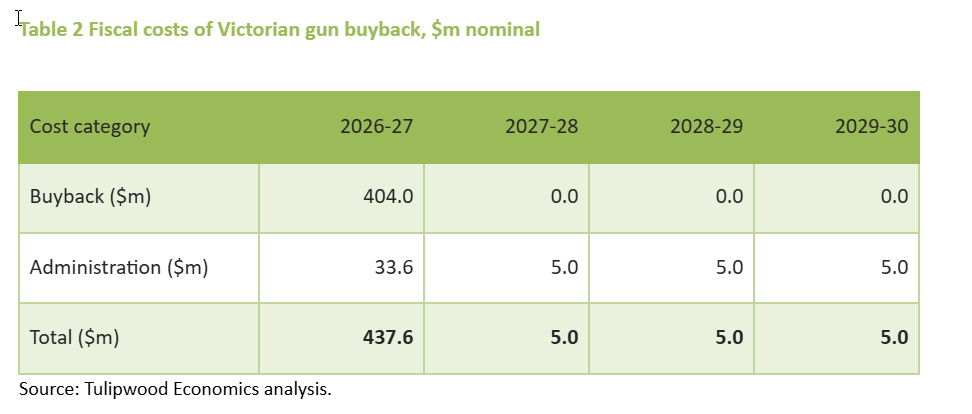
A Victorian firearm buyback scheme would impose substantial costs while failing to achieve its stated objectives. The econometric and statistical evidence does not support the proposition that reductions in the firearm stock would lead to a measurable decline in mass shootings. These events are rare, driven by complex factors, and not credibly explained by changes in aggregate firearm ownership. As a result, the central policy rationale for a large-scale buyback is not supported by the available data.
It cannot be recommended as an effective or efficient policy response to gun-related harm in Victoria